


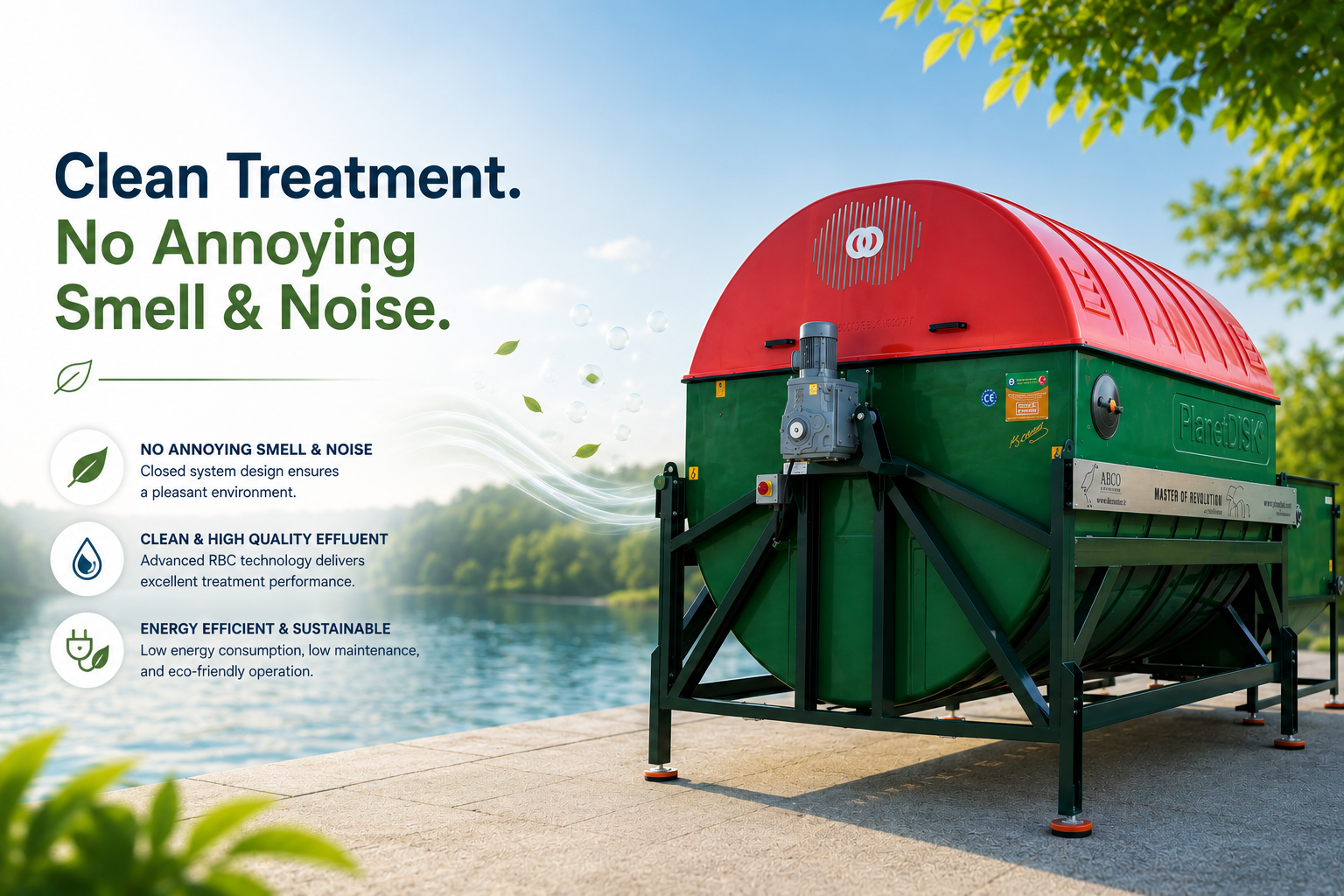

For most people considering wastewater treatment, the first worry is the same: “What if it smells?” For a plant near a hotel, a residential area, or a business, that’s a fair concern. The good news: odor is not inevitable. In this article, we explain why odor forms and how it is prevented.
Where does wastewater odor come from?
That sharp, rotten-egg smell in wastewater is actually the result of a chemical process. Microorganisms break down the organic matter in wastewater. This breakdown can happen in two ways, and there is one critical factor that determines whether odor forms: oxygen.
When oxygen is insufficient (anaerobic process), microorganisms break down organic matter without oxygen. This process produces smelly gases — chiefly hydrogen sulfide (H₂S), the famous rotten-egg smell, and ammonia. This is the odor that gives wastewater plants their bad reputation.
When there is enough oxygen (aerobic process), the same microorganisms break down organic matter in a completely different way. The result is not smelly gases but odorless products: carbon dioxide, water, and biomass. Odor practically does not form.
So it really comes down to oxygen
The conclusion is clear: odor is not an accident but the direct result of a lack of oxygen. In poorly designed or under-aerated systems, wastewater goes oxygen-starved, the anaerobic process kicks in, and the smell begins.
A well-designed system, on the other hand, guarantees enough oxygen throughout treatment. That way the process runs aerobically from the start and never gives smelly gases a chance to form.
Why doesn’t RBC technology produce odor?
The odor-free operation of Rotating Biological Contactor (RBC) technology rests on exactly this principle. Because the rotating discs continuously move up into the air and back down into the water, the biofilm on the disc surfaces takes oxygen directly from the atmosphere with every rotation.
This provides a constant, natural flow of oxygen to the system without the need for energyhungry aeration systems that must continuously pump air. Because the process stays aerobic from beginning to end, smelly gases like H₂S and ammonia do not form. This is how a well-designed RBC system runs without giving off any unpleasant odor.
Why does odor-free treatment matter?
Odor is not just a comfort issue; it often determines where a project can be located. An odor-free system offers these advantages:
● Can be installed near residential areas, hotels, and businesses
● Protects guest and employee satisfaction
● Prevents neighbor complaints and the problems that follow
● Allows the plant to be placed in a visible, accessible location
In short, odor-free treatment means not just cleaner air, but more flexible siting and fewer problems.
Conclusion
Wastewater plants smelling is not a necessity — it is the result of a lack of oxygen. When enough oxygen is supplied throughout the process, smelly gases never form. RBC technology achieves exactly that, thanks to its natural and continuous oxygen supply. At PlanetTEK, our PlanetDISK® RBC technology delivers odor-free, quiet, and low-energy wastewater treatment solutions — systems that can operate safely right next to hotels, residential areas, and businesses. Looking for an odor-free solution for your project? Contact us for a free assessment.
 On-Location, Decentralized
No comments yet.